+44 7933 142807
 info@irelandassignment.help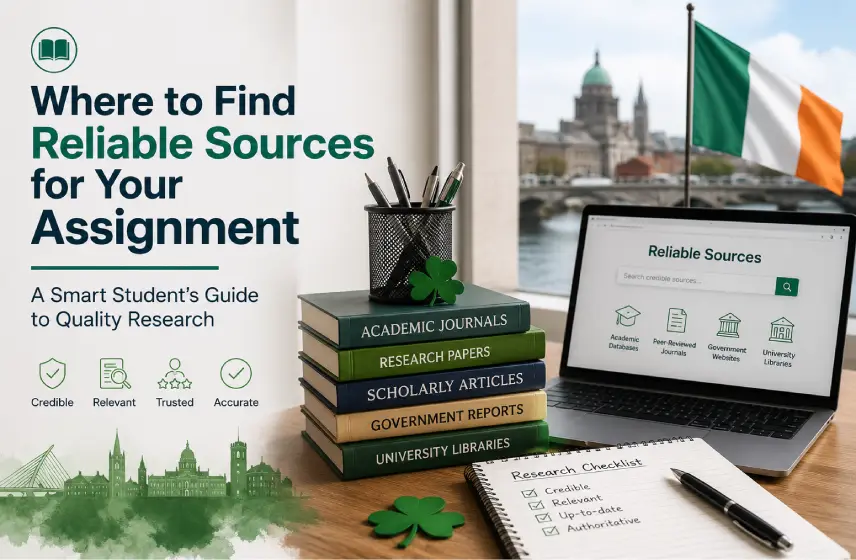
One of the most essential elements of academic work is the use of credible sources. These are the backbone of quality and strong research.
These sources are vital for the papers, essays, reports and thesis you will produce for the duration of your studies.
Once you utilise reputable, authentic sources, you will ensure your arguments are credible. And hence, you will deliver a high-quality, original paper.
However, in today’s tech era, there is plenty of information accessible on the internet. Not everything you discover on social media or Google is trustworthy.
So, the question is: how do you find genuine, factual information for your assignment? Credibility and reliability are key factors that play a huge role in shaping your findings.
Without high-quality, reliable sources, your paper will not look original or professional. Whether you are a student, educator, or independent researcher who needs guidance on finding a good source, this guide is for you.
What is a Reliable Source?
A reputable academic source is an academic publication written by experts in a particular field. And they are examined through rigorous quality-control practices such as peer review.
Moreover, all of these sources are well-researched, objective, and carefully cited to ensure the information is accurate, verifiable, and unbiased.
Here are the different types of academic sources for an assignment.
1. Scholarly Peer-Reviewed Articles or Books
These are written by researchers for learners and researchers. These are original research and comprise a huge bibliography.
These can be found on GALILEO's academic databases and Google Scholar.
2. Trade of Professional Articles or Books
These articles are mostly written by specialists and experts with expertise in a field to present practice-oriented information.
While few of these can be found via Google or other search engines. However, these are mostly paid texts that require payment.
3. Magazine Articles, Books and Newspaper Articles from Well-Known Newspapers
These are written for a broader or general audience by journalists or authors. These authors or journalists have consulted reliable sources before writing and have had their work examined by an editor.
In addition, these sources may offer a few of their articles for free and available online.
4. Websites and Blogs
These can be reliable or not reliable, or can be hoaxes or honest fabrications. Experts and researchers in the field often use blogs to share their knowledge and expertise with the general public.
These days, anyone with internet access can become a blogger.
So, it is up to you to examine and analyse the quality of what you find online.
How to Identify Credible Sources for an Assignment
In order to classify authentic sources for your research paper, you have to focus on peer-reviewed journals, academic books and official government or educational websites.
After that, you must weigh the authors' subject-matter expertise. Then examine publication dates to ensure the info is current. You have to verify that the source is unbiased and correctly cites its own references.
Here are effective tips for finding and classifying genuine sources to write a superior assignment.
-
Academic search engines: In the first step, you must find peer-reviewed papers using Google Scholar.
-
Cross-disciplinary databases- Now access, examine and analyse academic papers through JSTOR.
-
Government and health data: In the 3rd step, you must gather statistics and reports from the US Government Publishing Office.
-
Source verification: In the final step, you must assess the credibility and potential bias of unknown websites. For that, use media literacy tools such as Media Bias/ fact check.
Are you still unable to find academic sources after taking plenty of time for research?
Just go and connect with our team of specialist researchers, writers and tutors at Assignment Helper Ireland. Every team member in our agency is qualified and has years of experience. They will help you step by step with how to find reliable academic sources.
Connect Now!
How to Evaluate Internet Sources for Credibility?
To successfully calculate and analyse internet sources, you have to use the lateral reading method alongside the CRAAP framework (Currency, Relevance, Authority, Accuracy, Purpose). By doing so, it will ensure you do not take a website’s About Us page at face value. And rather prove the website claims via the wider web.
Difference Between Primary and Secondary Sources?
While Primary sources offer raw, firsthand proof or data, they mostly come from experiments, surveys, and interviews.
On the flip side, secondary sources interpret, analyse or sum up those primary sources. Here are some key differences between primary and secondary sources.
Primary Sources
Primary sources provide direct, complete access to a subject. These sources are mostly present original thinking, firsthand accounts or new findings.
Below are examples of primary sources
-
Humanities/History: Diaries, letters, photographs, speeches, and original artifacts.
-
Sciences: Raw data, lab notes, and original journal articles defining new experiments.
-
Law: Original court records, constitutions, and statutes.
-
Literature: The original novels, poems, or plays being studied
How to Search JSTOR for Primary Sources
To search JSTOR for primary sources, run an advanced search and enter your keywords. Later, use the filter panel on the results page to limit your results by item type. For instance, examine primary sources, such as manuscripts, pamphlets, or images.
Secondary Sources
Secondary sources are not the original event. These are created by someone who did not have firsthand experience or take part in the events or situations you are researching.
They access, synthesize and remark upon primary sources. These are examples of secondary sources
-
Humanities/History: Biographies, history textbooks, and documentaries.
-
Sciences: Review articles, meta-analyses, and textbooks.
-
Literature: Literary criticism or essays analyzing a specific poem
Winding it UP
Remember, finding reliable sources for writing a quality assignment is the cornerstone of academic success.
By using peer-reviewed articles from databases such as JSTOR and accessing content via the CRAAP framework.
You have to make sure your research is credible, unbiased and professional.