+44 7933 142807
 info@irelandassignment.help
Note-taking is a common activity for students. They learn this skill in schools and stand by it throughout their lives. However, every student uses different techniques to record lectures. Some use symbols or abbreviations. Some write in bullets.
But it doesn’t really matter how you write your notes. What matters here is that you should be able to understand your notes later. Most students who check their notebooks afterwards fail to comprehend their own handwriting. This is why it is very important to use the right approach, as it greatly affects your ability to retain the information.
In this study, you’ll explore the best note-taking methods and also learn how and where to use them.
Why Note-Taking Matter
Before we discuss further, let’s recall what note-taking is.
In simple words, it is the practice of recording information and organizing it into a structured format. Some students prefer writing by hand while others rely on digital tools or apps. Both ways are effective as long as you follow the suitable method. The key benefits are as follows:
Improves Your Learning Ability:
Your mind stays alert when you write down important stuff during lectures. This encourages an active listening habit inside you whenever you hear a teacher discuss topics. You also become better at processing information faster. Most students quickly convert big ideas into simple words that are easier to understand.
It is scientifically proven that when we write things down, it makes our brain store that knowledge for a long time. Furthermore, many students find notes valuable during exam preparation. With a glance, they can remember everything they’ve studied during the semester. This makes them revise easily before a test.
It is a psychological fact that when information is organized and neat, it starts making sense. It also keeps all the facts together in one place so you don’t feel distressed about looking through pages. Well-structured thoughts save you time from reading entire books again to just get your facts straight.
The Best Note-Taking Methods
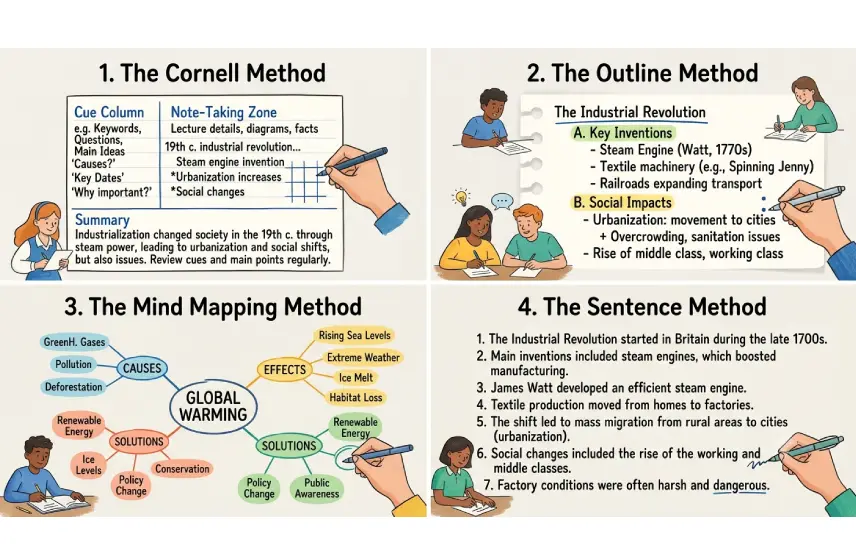
The following are the five best note-taking methods with their uses:
1. The Cornell Note-Taking Method:
If you like keeping your notes organized and structured, this method is for you. Designed by Cornell University professor Walter Pauk, it helps you quickly revisit and review your notes.
Follow these steps to take notes using the Cornell method:
● Divide your page into three sections: Cue column, Note-taking zone, and summary
● The page must have two unequal vertical columns. You can use the left side for the Cue keywords and the right side with more space for detailed notes.
● Use the lower one-third of the page to create a summary area from the vertical columns.
● Summarize your thoughts at the bottom.
When to use it: This method works well in classes, training sessions, or workshops. You can turn main ideas into short summaries, which are easy to remember. However, this method is not suitable for technical topics.
2. The Outline Method:
This is one of the simplest and basic note-taking methods. You can structure the gathered information into a sequence for a logical flow. The lengthy information gets organized into headings and subheadings.
Here is how to use the outline approach:
● Write the title of the main topic on the far left of your page
● Below the main topic, use bullet points to add the subtopic heading toward the right side.
● Expand your notes with facts, quotes, or questions below.
When to use it: You can use this method during classroom lectures, presentations, or general meetings. Before using this approach, you must recognize whether your subject falls into the categories of topics and subtopics. Students of QQI training can use this method effectively. They can also seek QQI assignment help in Ireland to structure their writing with outlined notes. It helps them connect the dots between review questions.
Do you find it difficult to structure your notes?
Get professional assistance from writing experts to organize your ideas.
Join Our Live Chat Today!3. The Mind Mapping Method:
If you prefer to figure information out visually, this is a perfect approach for you. In both education and business fields, people draw visual maps or diagrams to highlight the connection between ideas. Studies have also found that mapping out dense information reduces your cognitive overload.
Follow these steps to draw a visual mind map:
● Start by mentioning the topic’s name at the top of the page
● Draw branches for subtopics stemming from the main topic
● Divide the subtopics into more categories for further details
● Mention your notes relevant to each subtopic
When to use it: The final result literally looks like a family tree. You can also show your creativity by using colors or symbols. This method works best for interrelated, broad concepts that need to be explained on a whiteboard or a chart paper. Mapping helps you remember all points visually. However, as space is limited, be careful with the placement.
4. The Sentence Method:
This straightforward method is best for busy students who don’t care about visuals or structure in their notes. You can freely write every idea into a full sentence. It works best in a fast-paced setting where you cover several ideas and pieces of information. It’s your choice whether to use it for handwritten notes or digital notes.
Here is how you can create better notes with the sentence method:
● Write terms, statistics, or facts in plain sentences.
● Keep moving to the next sentence for a different idea.
● You can also assign numbers to new sentences for each main topic.
When to use it: It works best for unexpected discussions where knowledge flows quickly. This includes live training sessions, online meetings, and news channels. It is when recording matters the most rather than organization. You can later rewrite these notes into proper structure. The only disadvantage is that you may find it difficult to review the notes later as they’re cluttered.
The Bottom Line!
It doesn’t matter which method you choose. But you need to ensure you understand all of the information when you later open your notes for revision or thought processing.