+44 7933 142807
 info@irelandassignment.help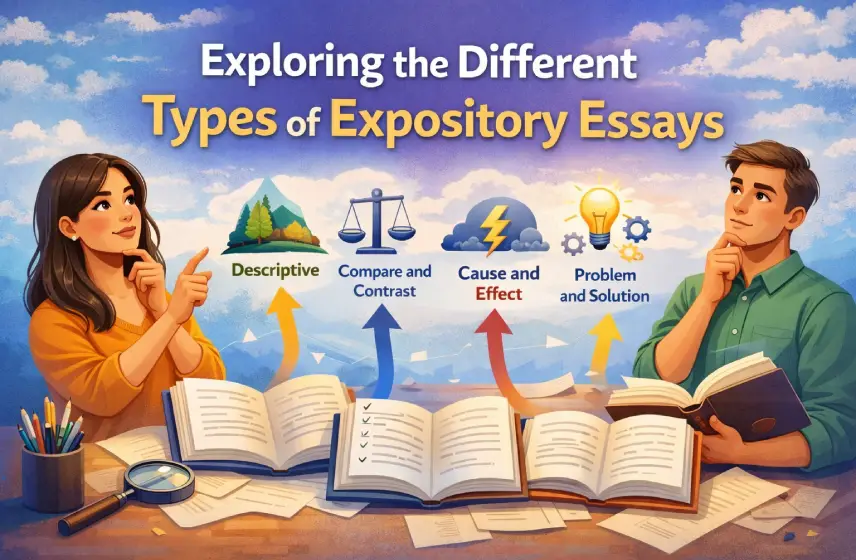
Being a student, you receive plenty of expository assignments; however, you feel lost and do not know how to start or what to include.
Well, the problem a lot of students face while writing an expository essay is that they often confuse it with argumentative or persuasive writing.
Hence, their essays wind up vague, unfocused and have no proper structure. These expository papers are all about clarity, informing the topic and adding facts and evidence, instead of personal opinions.
Whether you are a high school, university or even ESL learner and want to boost your writing skills, you need to grasp first an expository essay, its types and features.
Here in the next section, I will show you.
What is an Expository Essay?
In simple words, an expository essay is a kind of academic writing, where the writer explains, inform or describes the topic.
Rather than express their own ideas and personal thoughts, it depends on facts, logical structure and a clear tone to connect ideas.
In contrast to argumentative essays, which debate on a certain point, expository papers remain neutral and talk about the facts and accurate info.
Moreover, these essays are different from narrative essays as well, where authors use personal storytelling techniques. But rather than using personal stories, an expository essay depends on logic, a structured analysis and uses supporting evidence in order to inform the reader.
What is the structure of an Expository Essay?
Here is the basic structure of an expository paper you need to follow.
-
Intro- In the intro section, you need to introduce the topic and present a clear argument.
-
Body section- Every paragraph of a body section aim on one main idea, and every idea must be backed up with facts, examples or data.
-
Conclusion- To conclude it, the final section recaps the main points and supports the thesis without including new info.
Different Types of Expository Essays
There are plenty of types of expository essays. Once you understand the types, you can easily select the right one and structure your writing for different aims.
Below are some common types of Expository papers.
1. Descriptive Essays
In this essay, you paint the picture for your readers. This essay uses the sensory elements in order to make a vivid understanding for the readers, like smell, taste, touch and sight.
For example, rather than saying “the cake was good,” you may say, “the warm, rich aroma of chocolate filled the air, and each bite melted in my mouth, leaving a sweet aftertaste.”
2. Process Essay
In the process essay, you need to explain step by step how to bake a cake, drive a car or prepare for exams.
It is widely used in the field of cooking, tech and science. Common examples of process essays include " How to Assemble a Bookshelf" or "The Process of Photosynthesis.
3. Exploratory Essay
These kinds of expository essays take a question and then explore it from a lot of points of view. It does not argue a single conclusion.
Examples:
-
Is Modern tech a Blessing or a Curse
-
Exploring different methods to manage personal anxiety".
4. Compare and contrast essay
In this essay, you underline and explore the similarities and differences between the two subjects. Once you do this, it will help your reader understand how things are similar and how they are different.
Examples of a compare and contrast essay.
-
Public vs. private schools, city life vs. country life, capitalism vs. socialism.
5. Problem and Solution Essay
Here in a problem and solution essay, you need to identify the problem, then suggest the solution.
For that, you must clarify the problem and analyse possible solutions. And then finally debate the best one built on an argument.
This kind of essay is widely used in academic writing, policy and business reports.
Examples:
-
Taxing sugary drinks and implementing calorie labelling on menus.
-
How to decrease plastic waste?
If you want to learn more in-depth, then enrol in an online class from a reputable Ireland Assignment Help. The brand has a team of skilled and seasoned tutors.
What is the difference between an expository essay and an essay?
The meaning of an expository essay is to inform the reader about a certain topic. Also, this essay uses facts and evidence to back up the points.
While writing an expository essay, you may clarify why or how something is done. Or you can also explain a passage of a piece of literature.
This kind of essay as well avoid personal bias, as this is a formal essay. So, you must not use a first person pronouns such as I, me, we and ours. And do not use any second person pronouns as well, like you and you.
On the flip side, the essay is very much wider as the writer can use their personal ideas and thoughts. But it can depend on the requirements for the essay; this can generally become a personal essay.
It means you can use a first person pronouns such as I, me and my. In both essay styles, you must ignore writing second pronouns you and your.
What is the aim of Expository Essays?
The aim of expository essays is to clarify an idea by using factual info. It provides accurate info and avoids using personal opinions.
Below is the aim of an expository paper.
-
Inform and educate the readers about a certain topic
-
Clarify how something works or what the reasons are
-
Explore evidence in order to draw clear conclusions
Expository Essay Topics
Selecting the right topic for an expository is key to success. A solid topic has the features of clear, specific and informative.
Below are the ideas and examples of expository essays.
-
How social media affects teenagers' mental health.
-
The impact of artificial intelligence on modern healthcare.
-
Benefits of community service during high school.
-
The impact of climate change on coastal cities.
-
How did the Industrial Revolution change working conditions?
-
The role of pop culture in shaping teenage identity.
-
How to conduct a simple science experiment at home?
-
The process of how paper is made.